¶ SSO Stats & Info
If your assocation is also a Tangilla SSO customer, the SSO Stats & Info section will give you insight into the user's SSO information (Mobile Number and SSO User Name) and the actions taken by a member in their account.
In the Single Sign On section you can audit a member’s authentication history. The header shows the SSO User Name and Mobile Number, while a Filter drop-down on the right narrows the log by event type and an SMS Override toggle lets staff disable text-based two-factor prompts when necessary. The activity table records each action with five columns—Date, Event (such as “Login,” “Device Added,” or “SMS Sent”), Detail (browser or phone number), IP Address, and any Error returned—giving you a concise, chronological view of every login attempt and security-related change for this account.
¶ The SSO Stats & Info Dashboard
The information in the stats includes date, event, pertenent details, the IP address associated with the event, and any error messages associated with the event. You may also filter by event type. The following event types are tracked; SMS Sent, Device Added, Login, Logout, Login Error, Logout Error, Reset Password, Reset Password Error, Send Reset Password, Send Reset Password Error, Update Email, Update Email Error, Update Password, and Update Password Error.
¶ Event Definitions
- SMS Sent: An SMS (Short Message Service) message was successfully sent to the user's registered mobile number. This event often happens during multi-factor authentication or a password recovery process.
- Device Added: A new device, like a phone, tablet, or computer, has been successfully registered to the user's account. This usually occurs when a user signs in from a new browser or device for the first time.
- Login: The user has successfully authenticated and gained access to the system.
- Logout: The user has successfully ended their session and left the system.
- Login Error: A user's attempt to log in has failed, which could be due to incorrect credentials, an expired session, or other authentication issues.
- Logout Error: An error prevented the user's session from being properly terminated during a logout attempt. This is typically a technical issue.
- Reset Password: The user has successfully changed their password after requesting to do so (for example, after forgetting their old one). This event is logged once the new password is set.
- Reset Password Error: An attempt to reset a password failed. This can happen if the user enters an invalid token, the new password doesn't meet requirements, or a system-side error occurs.
- Send Reset Password: A request to start the password reset process has been triggered, such as when a user clicks "Forgot Password." This action sends a verification link or code to the user's email or phone.
- Send Reset Password Error: An attempt to send the password reset verification link or code failed. This might be because the email address is invalid, the account was not found, or a technical issue occurred.
- Update Email: The user has successfully changed the email address on their account.
- Update Email Error: An attempt to change the user's email address failed. This could be because the new email is invalid or already in use.
- Update Password: The user successfully changed their password while they were already logged into their account (as opposed to a password reset).
- Update Password Error: An attempt to update the user's password while logged in failed. This might be due to an invalid current password or the new password not meeting security requirements.
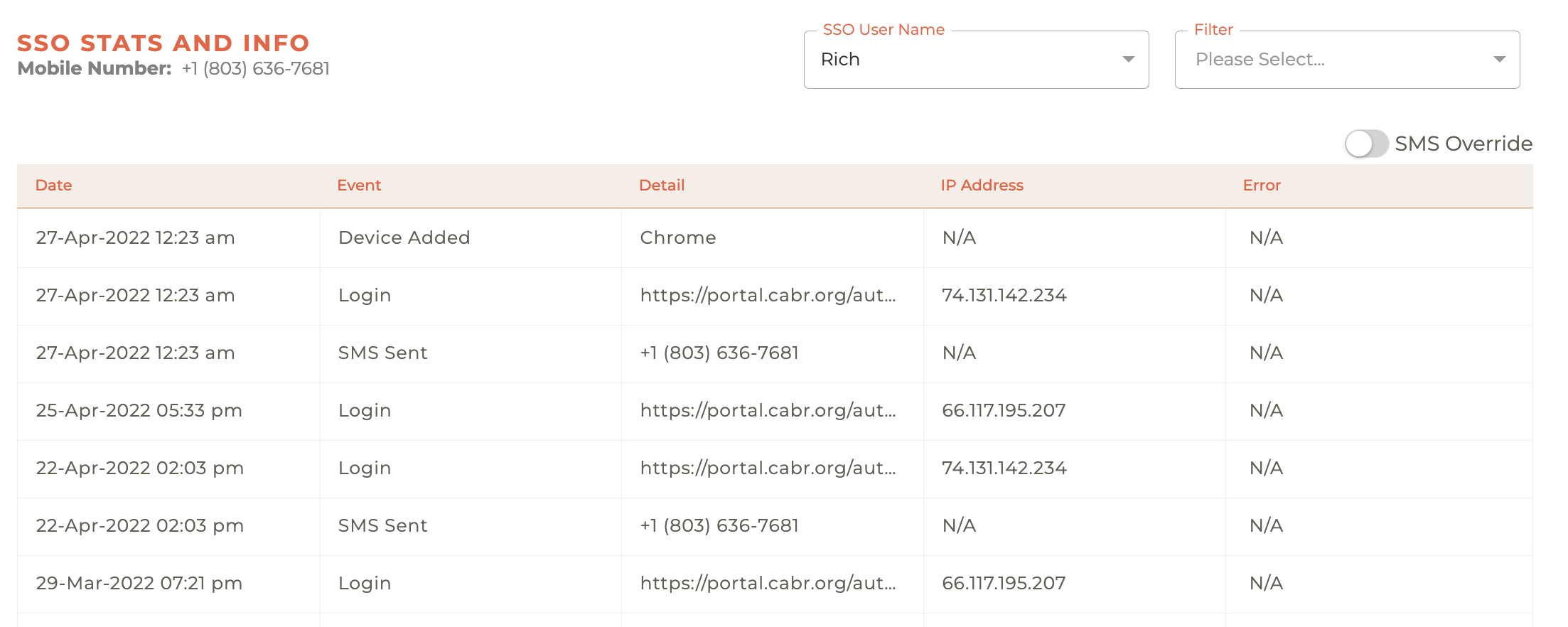
The table below the user information shows a chronological list of actions. The Date column shows when the event occurred. The Event column provides a high-level description of what happened, such as a "Login" or "Login Error." The Detail column offers additional context for certain events, like a device name for a "Device Added" event or a phone number for "SMS Sent." The IP Address column indicates the location from which the action originated. Finally, the Error column captures any error messages associated with the event, for example, "Invalid User Credentials" for a failed login. This log provides an audit trail of a user's activity within the system.
¶ N/A (Not Applicable) Responses For IP Address.
Because Tangilla only stores an IP address when the event actually comes from the member’s device. Login attempts will capture the client’s public IP, but system-generated actions—like SMS Sent (triggered by the server/Twilio) or Device Added events recorded during a behind-the-scenes enrollment—never touch the end user’s network, so there’s no client IP to log. You’ll also see N/A if the request passed through something that stripped the header (e.g., an old reverse proxy).
¶ N/A (Not Applicable) Responses For Errors.
“N/A” just means the system didn’t record an error for that event. The Error column only populates when something goes wrong—bad password, invalid token, SMS delivery failure, and so on. When the login, device-add, or SMS step finishes without a hiccup, Tangilla writes “N/A” (“not applicable”) to make it clear there was nothing to report.
Only the last 30 days of events are displayed for most event types except for
SMS SentandDevice Addedwhich are retained for a longer period.
¶ SMS Override
This dashboard will also allow you to set an SMS Override for situations where required. The SMS Overriden lasts for 7 days and, when set, will bypass 2 Factor Authentication for the user when accessing their account on a non-trusted device.
¶ SMS Number Used By Tangilla
The phone number that members will receive their text messages from is +1-844-973-4205.
¶ Frequently Asked Questions
| # | Question | Answer |
|---|---|---|
| 1 | What is the SSO Stats & Info section? | A dashboard that shows a user’s SSO information (SSO User Name and Mobile Number) and a chronological log of actions taken in their account. |
| 2 | Who sees the SSO Stats & Info section? | Associations that are Tangilla SSO customers. |
| 3 | What appears in the Single Sign On header? | The SSO User Name and Mobile Number. |
| 4 | What does the Filter drop-down do? | It narrows the activity log by event type. |
| 5 | What is the SMS Override toggle for? | It lets staff disable text-based two-factor prompts when necessary. |
| 6 | How long does an SMS Override last? | 7 days. |
| 7 | What does SMS Override change for the user? | For 7 days it bypasses 2-Factor Authentication when the user signs in on a non-trusted device. |
| 8 | Which columns are in the activity table? | Date, Event, Detail, IP Address, and Error. |
| 9 | What does the Detail column show? | Extra context, such as a browser/device name for “Device Added” or a phone number for “SMS Sent.” |
| 10 | What does the IP Address column indicate? | The IP from which the action originated. |
| 11 | What does the Error column show? | Any error message returned for that event; otherwise N/A. |
| 12 | Which event types are tracked? | SMS Sent, Device Added, Login, Logout, Login Error, Logout Error, Reset Password, Reset Password Error, Send Reset Password, Send Reset Password Error, Update Email, Update Email Error, Update Password, Update Password Error. |
| 13 | What does “SMS Sent” mean? | An SMS message was successfully sent to the user’s registered mobile number (often for MFA or password recovery). |
| 14 | What does “Device Added” mean? | A new device/browser was registered to the user’s account (typically first sign-in on that device). |
| 15 | What does “Login” mean? | The user successfully authenticated. |
| 16 | What does “Logout” mean? | The user successfully ended their session. |
| 17 | What is a “Login Error”? | A failed login attempt (e.g., bad credentials or other authentication issues). |
| 18 | What is a “Logout Error”? | An error prevented a session from ending properly. |
| 19 | What is “Reset Password”? | The user successfully changed their password after initiating a reset request. |
| 20 | What is a “Reset Password Error”? | A password reset attempt failed (e.g., invalid token or requirements not met). |
| 21 | What is “Send Reset Password”? | The system initiated the password-reset process by sending a verification link/code. |
| 22 | What is a “Send Reset Password Error”? | Sending the reset verification failed (e.g., invalid email/account not found/technical issue). |
| 23 | What is “Update Email”? | The user successfully changed the email address on their account. |
| 24 | What is an “Update Email Error”? | An attempt to change the user’s email failed (e.g., invalid or already in use). |
| 25 | What is “Update Password”? | The user changed their password while already logged in (not a reset). |
| 26 | What is an “Update Password Error”? | A logged-in password change failed (e.g., wrong current password or new password requirements not met). |
| 27 | Why might IP Address show “N/A”? | Tangilla stores an IP only when the event comes from the member’s device; server-generated actions (e.g., SMS Sent via server/Twilio) or header-stripping proxies can result in N/A. |
| 28 | Why might Error show “N/A”? | No error was recorded for that event (nothing went wrong). |
| 29 | How far back does the log go? | Generally the last 30 days of events, except “SMS Sent” and “Device Added,” which are retained longer. |
| 30 | What overall view does the table provide? | A concise, chronological audit trail of logins and security-related changes for the account. |
| 31 | What phone number do Tangilla SMS messages come from? | +1-844-973-4205. |